Learning an instrument shouldn’t mean spending years playing music you don’t actually like.
For many children, the moment they recognise a song they love on the piano, guitar or drums is the moment something changes.
Suddenly, they’re not just completing another exercise.
They’re playing their music.
And that can have a much bigger impact on their development than parents might expect.
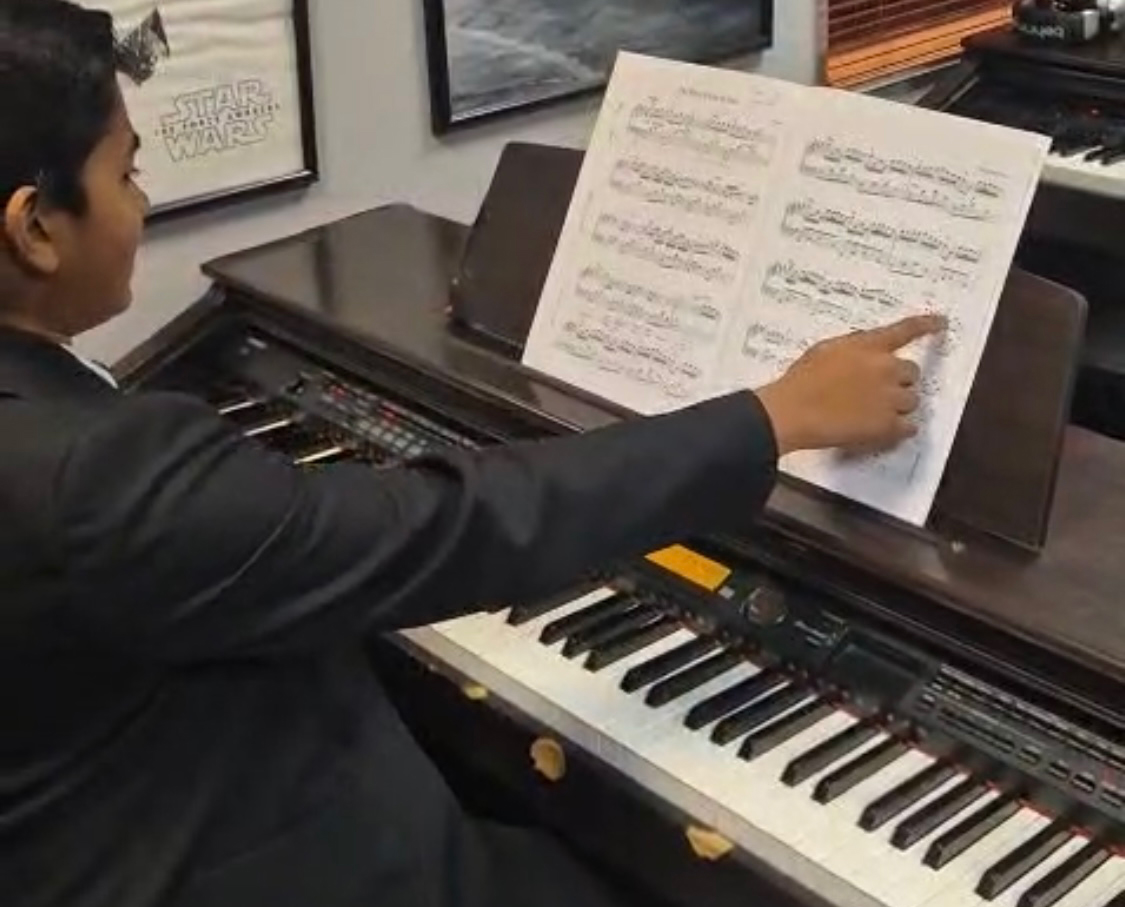
“Can we learn this song?”
It’s a question music teachers hear all the time.
A student hears something on the radio, watches a film, discovers a song on YouTube or hears an older sibling playing something and wants to have a go.
Sometimes it’s a straightforward pop song. Sometimes it’s a rock classic. Sometimes it’s something completely unexpected.
The instinct can be to think that these songs are a distraction from “proper” learning.
In reality, they can be one of the most useful teaching tools a music teacher has.
A song that a student genuinely wants to learn gives them a reason to practise, a reason to listen and a reason to overcome the difficult bits.
And that motivation matters.
Motivation changes the way we learn
Learning an instrument takes time.
There will always be moments when something feels difficult. A rhythm doesn’t quite work. A chord change is awkward. A piece needs another ten attempts before it starts to sound right.
If the student doesn’t particularly care about the music, it’s easy for those difficulties to become frustrating.
But when they’re determined to learn a song they love, the difficult part becomes something they need to overcome to reach a goal they actually care about.
That’s a very different mindset.
Instead of:
“I have to practise this.”
It becomes:
“I want to be able to play this.”
That distinction can make a huge difference.
But aren’t students supposed to learn the basics first?
Of course they are.
Technique, rhythm, reading, theory, listening and musical understanding all matter.
The important point is that learning music you enjoy doesn’t have to replace those things. It can help teach them.
Take a familiar song.
A teacher might use it to explore:
-
Rhythm and timing
-
Chord patterns
-
Scales and melody
-
Repetition and song structure
-
Dynamics
-
Articulation
-
Technique
-
Listening
-
Notation
-
Improvisation
-
Performance
The student thinks they’re learning a song.
The teacher knows they’re developing musicianship.
That’s good teaching.
Real music creates real questions
There’s another benefit to using music students already know.
It gives them something to compare their playing with.
If a student has listened to a song hundreds of times, they already have an idea of how it should sound.
That means they can start asking useful musical questions.
Why does that chord sound like that?
Why does the chorus feel bigger?
Why does the drummer play that rhythm?
Why does the melody work over those chords?
Why does the song suddenly sound different here?
Those questions are incredibly valuable.
They’re the beginning of musical understanding.
Instead of simply being told that a particular chord is a dominant seventh or that a particular rhythm is syncopated, the student can hear it in a piece of music they already understand.
The theory suddenly has a purpose.
Playing songs can make you a more independent musician
One of the biggest goals of music education should be helping students become less dependent on their teacher.
Eventually, we’d like a student to be able to hear something and think:
“I want to play that.”
Then work out how.
That might mean finding the melody by ear, identifying the chords, figuring out the rhythm or searching for a suitable arrangement.
Those skills don’t come from simply following instructions.
They develop through listening, experimenting and understanding how music works.
This is one reason we place importance on aural skills, music theory, creativity and practical playing alongside traditional instrumental technique.
A musician who understands what they’re doing has far more options than someone who can only reproduce something they’ve been shown.
It doesn’t have to be the latest pop song
“Learning the music you love” doesn’t mean every lesson has to involve the latest chart hit.
For one student, it might be a current pop song.
For another, it could be a film soundtrack.
Someone else might want to learn a rock classic, a football anthem or a song their parents grew up listening to.
The important thing is that it means something to the student.
We’ve seen this with Presto students learning everything from Green Onions and Californication to You’ll Never Walk Alone.
They’re very different pieces of music, but they all have something in common.
The student wants to play them.
And that gives the teacher something powerful to work with.
The teacher’s role is to make the song work for the student
Sometimes the original version of a song is simply too difficult.
That doesn’t mean the student has to wait years before they can play it.
A good teacher can adapt it.
Perhaps the rhythm needs simplifying.
Maybe the arrangement needs changing.
Perhaps only the main riff is appropriate at first.
The student might learn a simplified version and gradually build towards the original.
This is particularly important with younger students.
The aim isn’t to give them something that’s technically impressive but completely beyond their ability.
The aim is to give them something that is challenging enough to develop their skills, but achievable enough to keep them motivated.
That’s where good teaching makes all the difference.
What happens when students enjoy what they’re learning?
They tend to want to play more.
They listen more carefully.
They become more curious.
They ask questions.
They start bringing their own ideas to lessons.
They want to perform.
And, perhaps most importantly, they begin to see themselves as musicians rather than simply someone who attends a music lesson every week.
That shift is important.
Because the long-term goal isn’t simply to get a child through their next piece or their next exam.
It’s to give them the confidence and skills to continue making music long after their formal lessons have finished.
Exams still have an important role
At Presto, we enter thousands of students for graded examinations and we’re proud of the results they achieve.
Exams provide structure, goals and a clear sense of progress.
But they’re one part of a much bigger musical journey.
A student shouldn’t finish an exam thinking:
“That’s it. I’ve learned music.”
They should finish thinking:
“What can I learn next?”
Perhaps that’s another grade.
Perhaps it’s a new instrument.
Perhaps it’s joining a band.
Perhaps it’s writing a song.
Or perhaps they simply want to learn the latest song they can’t stop listening to.
All of those are valid reasons to keep playing.
The best music lessons don’t feel like a choice between enjoyment and progress
You shouldn’t have to choose between learning “properly” and playing music you enjoy.
The two can work together.
In fact, when they’re combined well, they can make each other stronger.
The right song can motivate a student to practise technique.
A chord progression can lead to a theory lesson.
A melody can become an ear-training exercise.
A favourite track can become a composition project.
A group performance can develop timing and listening.
And a song the student desperately wants to learn can be the thing that keeps them practising when they might otherwise have given up.
That’s the approach we believe in at Presto.
Teach the skills. Use real music. Give students something they care about.
Because when a child doesn’t just learn music, but starts to love making it, that’s when the real journey begins.
Start learning the music you love
At Presto Music School, we combine structured learning with real music, practical playing, performance and creativity.
Whether you’re starting from scratch or looking to take your playing further, our teachers work with each student to build their skills while keeping music enjoyable.
We offer lessons in piano, keyboard, guitar, drums and vocals, alongside specialist courses in music theory, composition and music production.
Book a free trial lesson and find out what learning music at Presto could look like for you.